Thank you. I'm honored to be with you today for your commencement from one of the finest universities in the world. Truth be told, I never graduated from college and this is the closest I've ever gotten to a college graduation.
Today I want to tell you three stories from my life. That's it. No big deal. Just three stories. The first story is about connecting the dots.
I dropped out of Reed College after the first six months but then stayed around as a drop-in for another eighteen months or so before I really quit. So why did I drop out? It started before I was born. My biological mother was a young, unwed graduate student, and she decided to put me up for adoption. She felt very strongly that I should be adopted by college graduates, so everything was all set for me to be adopted at birth by a lawyer and his wife, except that when I popped out, they decided at the last minute that they really wanted a girl. So my parents, who were on a waiting list, got a call in the middle of the night asking, "We've got an unexpected baby boy. Do you want him?" They said, "Of course." My biological mother found out later that my mother had never graduated from college and that my father had never graduated from high school. She refused to sign the final adoption papers. She only relented a few months later when my parents promised that I would go to college.
This was the start in my life. And seventeen years later, I did go to college, but I naïvely chose a college that was almost as expensive as Stanford, and all of my working-class parents' savings were being spent on my college tuition. After six months, I couldn't see the value in it. I had no idea what I wanted to do with my life, and no idea of how college was going to help me figure it out, and here I was, spending all the money my parents had saved their entire life. So I decided to drop out and trust that it would all work out OK. It was pretty scary at the time, but looking back, it was one of the best decisions I ever made. The minute I dropped out, I could stop taking the required classes that didn't interest me and begin dropping in on the ones that looked far more interesting.
It wasn't all romantic. I didn't have a dorm room, so I slept on the floor in friends' rooms. I returned Coke bottles for the five-cent deposits to buy food with, and I would walk the seven miles across town every Sunday night to get one good meal a week at the Hare Krishna temple. I loved it. And much of what I stumbled into by following my curiosity and intuition turned out to be priceless later on. Let me give you one example.
Reed College at that time offered perhaps the best calligraphy instruction in the country. Throughout the campus every poster, every label on every drawer was beautifully hand-calligraphed. Because I had dropped out and didn't have to take the normal classes, I decided to take a calligraphy class to learn how to do this. I learned about serif and sans-serif typefaces, about varying the amount of space between different letter combinations, about what makes great typography great. It was beautiful, historical, artistically subtle in a way that science can't capture, and I found it fascinating.
None of this had even a hope of any practical application in my life. But ten years later when we were designing the first Macintosh computer, it all came back to me, and we designed it all into the Mac. It was the first computer with beautiful typography. If I had never dropped in on that single course in college, the Mac would have never had multiple typefaces or proportionally spaced fonts, and since Windows just copied the Mac, it's likely that no personal computer would have them.
If I had never dropped out, I would have never dropped in on that calligraphy class and personals computers might not have the wonderful typography that they do.
Of course it was impossible to connect the dots looking forward when I was in college, but it was very, very clear looking backwards 10 years later. Again, you can't connect the dots looking forward. You can only connect them looking backwards, so you have to trust that the dots will somehow connect in your future. You have to trust in something--your gut, destiny, life, karma, whatever--because believing that the dots will connect down the road will give you the confidence to follow your heart, even when it leads you off the well-worn path, and that will make all the difference.
My second story is about love and loss. I was lucky. I found what I loved to do early in life. Woz and I started Apple in my parents' garage when I was twenty. We worked hard and in ten years, Apple had grown from just the two of us in a garage into a $2 billion company with over 4,000 employees. We'd just released our finest creation, the Macintosh, a year earlier, and I'd just turned thirty, and then I got fired. How can you get fired from a company you started? Well, as Apple grew, we hired someone who I thought was very talented to run the company with me, and for the first year or so, things went well. But then our visions of the future began to diverge, and eventually we had a falling out. When we did, our board of directors sided with him, and so at thirty, I was out, and very publicly out. What had been the focus of my entire adult life was gone, and it was devastating. I really didn't know what to do for a few months. I felt that I had let the previous generation of entrepreneurs down, that I had dropped the baton as it was being passed to me. I met with David Packard and Bob Noyce and tried to apologize for screwing up so badly. I was a very public failure and I even thought about running away from the Valley. But something slowly began to dawn on me. I still loved what I did. The turn of events at Apple had not changed that one bit. I'd been rejected but I was still in love. And so I decided to start over.
I didn't see it then, but it turned out that getting fired from Apple was the best thing that could have ever happened to me. The heaviness of being successful was replaced by the lightness of being a beginner again, less sure about everything. It freed me to enter one of the most creative periods in my life. During the next five years I started a company named NeXT, another company named Pixar and fell in love with an amazing woman who would become my wife. Pixar went on to create the world's first computer-animated feature film, "Toy Story," and is now the most successful animation studio in the world.
In a remarkable turn of events, Apple bought NeXT and I returned to Apple and the technology we developed at NeXT is at the heart of Apple's current renaissance, and Lorene and I have a wonderful family together.
I'm pretty sure none of this would have happened if I hadn't been fired from Apple. It was awful-tasting medicine but I guess the patient needed it. Sometimes life's going to hit you in the head with a brick. Don't lose faith. I'm convinced that the only thing that kept me going was that I loved what I did. You've got to find what you love, and that is as true for work as it is for your lovers. Your work is going to fill a large part of your life, and the only way to be truly satisfied is to do what you believe is great work, and the only way to do great work is to love what you do. If you haven't found it yet, keep looking, and don't settle. As with all matters of the heart, you'll know when you find it, and like any great relationship it just gets better and better as the years roll on. So keep looking. Don't settle.
My third story is about death. When I was 17 I read a quote that went something like "If you live each day as if it was your last, someday you'll most certainly be right." It made an impression on me, and since then, for the past 33 years, I have looked in the mirror every morning and asked myself, "If today were the last day of my life, would I want to do what I am about to do today?" And whenever the answer has been "no" for too many days in a row, I know I need to change something. Remembering that I'll be dead soon is the most important thing I've ever encountered to help me make the big choices in life, because almost everything--all external expectations, all pride, all fear of embarrassment or failure--these things just fall away in the face of death, leaving only what is truly important. Remembering that you are going to die is the best way I know to avoid the trap of thinking you have something to lose. You are already naked. There is no reason not to follow your heart.
About a year ago, I was diagnosed with cancer. I had a scan at 7:30 in the morning and it clearly showed a tumor on my pancreas. I didn't even know what a pancreas was. The doctors told me this was almost certainly a type of cancer that is incurable, and that I should expect to live no longer than three to six months. My doctor advised me to go home and get my affairs in order, which is doctors' code for "prepare to die." It means to try and tell your kids everything you thought you'd have the next ten years to tell them, in just a few months. It means to make sure that everything is buttoned up so that it will be as easy as possible for your family. It means to say your goodbyes.
I lived with that diagnosis all day. Later that evening I had a biopsy where they stuck an endoscope down my throat, through my stomach into my intestines, put a needle into my pancreas and got a few cells from the tumor. I was sedated but my wife, who was there, told me that when they viewed the cells under a microscope, the doctor started crying, because it turned out to be a very rare form of pancreatic cancer that is curable with surgery. I had the surgery and, thankfully, I am fine now.
This was the closest I've been to facing death, and I hope it's the closest I get for a few more decades. Having lived through it, I can now say this to you with a bit more certainty than when death was a useful but purely intellectual concept. No one wants to die, even people who want to go to Heaven don't want to die to get there, and yet, death is the destination we all share. No one has ever escaped it. And that is as it should be, because death is very likely the single best invention of life. It's life's change agent; it clears out the old to make way for the new. right now, the new is you. But someday, not too long from now, you will gradually become the old and be cleared away. Sorry to be so dramatic, but it's quite true. Your time is limited, so don't waste it living someone else's life. Don't be trapped by dogma, which is living with the results of other people's thinking. Don't let the noise of others' opinions drown out your own inner voice, heart and intuition. They somehow already know what you truly want to become. Everything else is secondary.
When I was young, there was an amazing publication called The Whole Earth Catalogue, which was one of the bibles of my generation. It was created by a fellow named Stuart Brand not far from here in Menlo Park, and he brought it to life with his poetic touch. This was in the late Sixties, before personal computers and desktop publishing, so it was all made with typewriters, scissors, and Polaroid cameras. it was sort of like Google in paperback form thirty-five years before Google came along. I was idealistic, overflowing with neat tools and great notions. Stuart and his team put out several issues of the The Whole Earth Catalogue, and then when it had run its course, they put out a final issue. It was the mid-Seventies and I was your age. On the back cover of their final issue was a photograph of an early morning country road, the kind you might find yourself hitchhiking on if you were so adventurous. Beneath were the words, "Stay hungry, stay foolish." It was their farewell message as they signed off. "Stay hungry, stay foolish." And I have always wished that for myself, and now, as you graduate to begin anew, I wish that for you. Stay hungry, stay foolish.
Thank you all, very much.
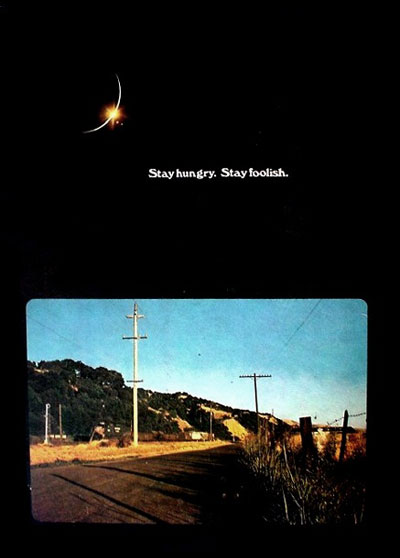
Maradjunk éhesek, maradjunk bolondok.
Nekem ezt nem kell kétszer mondani...
Hát itt ugye megint az a kérdés, hogy elhiggyük-e ezt, ráálljunk-e erre, vagy térjünk vissza a valóság talajára, és tudatosítsuk magunkban, hogy: "this is not America...."
És főleg, hogy vajon mit gondol erről az Úr?
Elizabeth Gilbert a kreativitás ápolásáról
Ezt írták róla a TED-en:
Elizabeth Gilbert megosztja velünk gondolatait arról, hogy milyen lehetetlen elvárásokat támasztunk a művészekkel és a zsenikkel szemben. Felveti azt az átütően új megközelítést, hogy a zseni nem önmaga zseniális, hanem benne él a zsenialitás szelleme. Szórakoztató, közvetlen és magával ragadó beszédet hallunk.Hát nem annyira átütően új ez a megközelítés, hiszen ő maga hivatkozik a görögökre meg a rómaiakra, de igazán megnyugtató, hogy egy ma sikeres író is eljut ide. Nagyon szép beszéd, és tisztára továbbgondolható a (lelki) ajándékainkhoz való viszonyulásra is.
A View subtitles gombra kattintva (és a Hungarian-t választva) előcsalogathatjuk a magyar feliratozást.
I am a writer. Writing books is my profession but it's more than that, of course. It is also my great lifelong love and fascination.
And I don't expect that that's ever going to change. But, that said, something kind of peculiar has happened recently in my life and in my career, which has caused me to have to recalibrate my whole relationship with this work. And the peculiar thing is that I recently wrote this book, this memoir called "Eat, Pray, Love" which, decidedly unlike any of my previous books, went out in the world for some reason, and became this big, mega-sensation, international bestseller thing. The result of which is that everywhere I go now, people treat me like I'm doomed. Seriously -- doomed, doomed! Like, they come up to me now, all worried, and they say, "Aren't you afraid -- aren't you afraid you're never going to be able to top that? Aren't you afraid you're going to keep writing for your whole life and you're never again going to create a book that anybody in the world cares about at all, ever again?"
So that's reassuring, you know. But it would be worse, except for that I happen to remember that over 20 years ago, when I first started telling people -- when I was a teenager -- that I wanted to be a writer, I was met with this same kind of, sort of fear-based reaction. And people would say, "Aren't you afraid you're never going to have any success? Aren't you afraid the humiliation of rejection will kill you? Aren't you afraid that you're going to work your whole life at this craft and nothing's ever going to come of it and you're going to die on a scrap heap of broken dreams with your mouth filled with bitter ash of failure?" (Laughter) Like that, you know.
The answer-- the short answer to all those questions is, "Yes." Yes, I'm afraid of all those things. And I always have been. And I'm afraid of many many more things besides that people can't even guess at. Like seaweed, and other things that are scary. But, when it comes to writing the thing that I've been sort of thinking about lately, and wondering about lately, is why? You know, is it rational? Is it logical that anybody should be expected to be afraid of the work that they feel they were put on this Earth to do. You know, and what is it specifically about creative ventures that seems to make us really nervous about each other's mental health in a way that other careers kind of don't do, you know? Like my dad, for example, was a chemical engineer and I don't recall once in his 40 years of chemical engineering anybody asking him if he was afraid to be a chemical engineer, you know? It didn't -- that chemical engineering block John, how's it going? It just didn't come up like that, you know? But to be fair, chemical engineers as a group haven't really earned a reputation over the centuries for being alcoholic manic-depressives. (Laughter)
We writers, we kind of do have that reputation, and not just writers, but creative people across all genres, it seems, have this reputation for being enormously mentally unstable. And all you have to do is look at the very grim death count in the 20th century alone, of really magnificent creative minds who died young and often at their own hands, you know? And even the ones who didn't literally commit suicide seem to be really undone by their gifts, you know. Norman Mailer, just before he died, last interview, he said "Every one of my books has killed me a little more." An extraordinary statement to make about your life's work, you know. But we don't even blink when we hear somebody say this because we've heard that kind of stuff for so long and somehow we've completely internalized and accepted collectively this notion that creativity and suffering are somehow inherently linked and that artistry, in the end, will always ultimately lead to anguish.
And the question that I want to ask everybody here today is are you guys all cool with that idea? Are you comfortable with that -- because you look at it even from an inch away and, you know -- I'm not at all comfortable with that assumption. I think it's odious. And I also think it's dangerous, and I don't want to see it perpetuated into the next century. I think it's better if we encourage our great creative minds to live.
And I definitely know that, in my case -- in my situation -- it would be very dangerous for me to start sort of leaking down that dark path of assumption, particularly given the circumstance that I'm in right now in my career. Which is -- you know, like check it out, I'm pretty young, I'm only about 40 years old. I still have maybe another four decades of work left in me. And it's exceedingly likely that anything I write from this point forward is going to be judged by the world as the work that came after the freakish success of my last book, right? I should just put it bluntly, because we're all sort of friends here now -- it's exceedingly likely that my greatest success is behind me. Oh, so Jesus, what a thought! You know that's the kind of thought that could lead a person to start drinking gin at nine o'clock in the morning, and I don't want to go there. (Laughter) I would prefer to keep doing this work that I love.
And so, the question becomes, how? And so, it seems to me, upon a lot of reflection, that the way that I have to work now, in order to continue writing, is that I have to create some sort of protective psychological construct, right? I have to, sort of find some way to have a safe distance between me, as I am writing, and my very natural anxiety about what the reaction to that writing is going to be, from now on. And, as I've been looking over the last year for models for how to do that I've been sort of looking across time, and I've been trying to find other societies to see if they might have had better and saner ideas than we have about how to help creative people, sort of manage the inherent emotional risks of creativity.
And that search has led me to ancient Greece and ancient Rome. So stay with me, because it does circle around and back. But, ancient Greece and ancient Rome -- people did not happen to believe that creativity came from human beings back then, OK? People believed that creativity was this divine attendant spirit that came to human beings from some distant and unknowable source, for distant and unknowable reasons. The Greeks famously called these divine attendant spirits of creativity "daemons." Socrates, famously, believed that he had a daemon who spoke wisdom to him from afar. The Romans had the same idea, but they called that sort of disembodied creative spirit a genius. Which is great, because the Romans did not actually think that a genius was a particularly clever individual. They believed that a genius was this, sort of magical divine entity, who was believed to literally live in the walls of an artist's studio, kind of like Dobby the house elf, and who would come out and sort of invisibly assist the artist with their work and would shape the outcome of that work.
So brilliant -- there it is, right there that distance that I'm talking about -- that psychological construct to protect you from the results of your work. And everyone knew that this is how it functioned, right? So the ancient artist was protected from certain things, like, for example, too much narcissism, right? If your work was brilliant you couldn't take all the credit for it, everybody knew that you had this disembodied genius who had helped you. If your work bombed, not entirely your fault, you know? Everyone knew your genius was kind of lame. And this is how people thought about creativity in the West for a really long time.
And then the Renaissance came and everything changed, and we had this big idea, and the big idea was let's put the individual human being at the center of the universe above all gods and mysteries, and there's no more room for mystical creatures who take dictation from the divine. And it's the beginning of rational humanism, and people started to believe that creativity came completely from the self of the individual. And for the first time in history, you start to hear people referring to this or that artist as being a genius rather than having a genius.
And I got to tell you, I think that was a huge error. You know, I think that allowing somebody, one mere person to believe that he or she is like, the vessel you know, like the font and the essence and the source of all divine, creative, unknowable, eternal mystery is just a smidge too much responsibility to put on one fragile, human psyche. It's like asking somebody to swallow the sun. It just completely warps and distorts egos, and it creates all these unmanageable expectations about performance. And I think the pressure of that has been killing off our artists for the last 500 years.
And, if this is true, and I think it is true, the question becomes, what now? Can we do this differently? Maybe go back to some more ancient understanding about the relationship between humans and the creative mystery. Maybe not. Maybe we can't just erase 500 years of rational humanistic thought in one 18 minute speech. And there's probably people in this audience who would raise really legitimate scientific suspicions about the notion of, basically fairies who follow people around rubbing fairy juice on their projects and stuff. I'm not, probably, going to bring you all along with me on this.
But the question that I kind of want to pose is -- you know, why not? Why not think about it this way? Because it makes as much sense as anything else I have ever heard in terms of explaining the utter maddening capriciousness of the creative process. A process which, as anybody who has ever tried to make something -- which is to say basically, everyone here --- knows does not always behave rationally. And, in fact, can sometimes feel downright paranormal.
I had this encounter recently where I met the extraordinary American poet Ruth Stone, who's now in her 90s, but she's been a poet her entire life and she told me that when she was growing up in rural Virginia, she would be out working in the fields, and she said she would feel and hear a poem coming at her from over the landscape. And she said it was like a thunderous train of air. And it would come barreling down at her over the landscape. And she felt it coming, because it would shake the earth under her feet. She knew that she had only one thing to do at that point, and that was to, in her words, "run like hell." And she would run like hell to the house and she would be getting chased by this poem, and the whole deal was that she had to get to a piece of paper and a pencil fast enough so that when it thundered through her, she could collect it and grab it on the page. And other times she wouldn't be fast enough, so she'd be running and running and running, and she wouldn't get to the house and the poem would barrel through her and she would miss it and she said it would continue on across the landscape, looking, as she put it "for another poet." And then there were these times -- this is the piece I never forgot -- she said that there were moments where she would almost miss it, right? So, she's running to the house and she's looking for the paper and the poem passes through her, and she grabs a pencil just as it's going through her, and then she said, it was like she would reach out with her other hand and she would catch it. She would catch the poem by its tail, and she would pull it backwards into her body as she was transcribing on the page. And in these instances, the poem would come up on the page perfect and intact but backwards, from the last word to the first. (Laughter)
So when I heard that I was like -- that's uncanny, that's exactly what my creative process is like. (Laughter)
That's not all what my creative process is -- I'm not the pipeline! I'm a mule, and the way that I have to work is that I have to get up at the same time every day, and sweat and labor and barrel through it really awkwardly. But even I, in my mulishness, even I have brushed up against that thing, at times. And I would imagine that a lot of you have too. You know, even I have had work or ideas come through me from a source that I honestly cannot identify. And what is that thing? And how are we to relate to it in a way that will not make us lose our minds, but, in fact, might actually keep us sane?
And for me, the best contemporary example that I have of how to do that is the musician Tom Waits, who I got to interview several years ago on a magazine assignment. And we were talking about this, and you know, Tom, for most of his life he was pretty much the embodiment of the tormented contemporary modern artist, trying to control and manage and dominate these sort of uncontrollable creative impulses that were totally internalized.
But then he got older, he got calmer, and one day he was driving down the freeway in Los Angeles he told me, and this is when it all changed for him. And he's speeding along, and all of a sudden he hears this little fragment of melody, that comes into his head as inspiration often comes, elusive and tantalizing, and he wants it, you know, it's gorgeous, and he longs for it, but he has no way to get it. He doesn't have a piece of paper, he doesn't have a pencil, he doesn't have a tape recorder.
So he starts to feel all of that old anxiety start to rise in him like, "I'm going to lose this thing, and then I'm going to be haunted by this song forever. I'm not good enough, and I can't do it." And instead of panicking, he just stopped. He just stopped that whole mental process and he did something completely novel. He just looked up at the sky, and he said, "Excuse me, can you not see that I'm driving?" (Laughter) "Do I look like I can write down a song right now? If you really want to exist, come back at a more opportune moment when I can take care of you. Otherwise, go bother somebody else today. Go bother Leonard Cohen."
And his whole work process changed after that. Not the work, the work was still oftentimes as dark as ever. But the process, and the heavy anxiety around it was released when he took the genie, the genius out of him where it was causing nothing but trouble, and released it kind of back where it came from, and realized that this didn't have to be this internalized, tormented thing. It could be this peculiar, wondrous, bizarre collaboration kind of conversation between Tom and the strange, external thing that was not quite Tom.
So when I heard that story it started to shift a little bit the way that I worked too, and it already saved me once. This idea, it saved me when I was in the middle of writing "Eat, Pray, Love," and I fell into one of those, sort of pits of despair that we all fall into when we're working on something and it's not coming and you start to think this is going to be a disaster, this is going to be the worst book ever written. Not just bad, but the worst book ever written. And I started to think I should just dump this project. But then I remembered Tom talking to the open air and I tried it. So I just lifted my face up from the manuscript and I directed my comments to an empty corner of the room. And I said aloud, "Listen you, thing, you and I both know that if this book isn't brilliant that is not entirely my fault, right? Because you can see that I am putting everything I have into this, I don't have anymore than this. So if you want it to be better, then you've got to show up and do your part of the deal. OK. But if you don't do that, you know what, the hell with it. I'm going to keep writing anyway because that's my job. And I would please like the record to reflect today that I showed up for my part of the job." (Laughter)
Because -- (Applause) in the end it's like this, OK -- centuries ago in the deserts of North Africa, people used to gather for these moonlight dances of sacred dance and music that would go on for hours and hours, until dawn. And they were always magnificent, because the dancers were professionals and they were terrific, right? But every once in a while, very rarely, something would happen, and one of these performers would actually become transcendent. And I know you know what I'm talking about, because I know you've all seen, at some point in your life, a performance like this. It was like time would stop, and the dancer would sort of step through some kind of portal and he wasn't doing anything different than he had ever done, 1,000 nights before, but everything would align. And all of a sudden, he would no longer appear to be merely human. He would be lit from within, and lit from below and all lit up on fire with divinity.
And when this happened, back then, people knew it for what it was, you know, they called it by it's name. They would put their hands together and they would start to chant, "Allah, Allah, Allah, God God, God." That's God, you know. Curious historical footnote -- when the Moors invaded southern Spain, they took this custom with them and the pronunciation changed over the centuries from "Allah, Allah, Allah," to "Ole, ole, ole," which you still hear in bullfights and in flamenco dances. In Spain, when a performer has done something impossible and magic, "Allah, ole, ole, Allah, magnificent, bravo," incomprehensible, there it is -- a glimpse of God. Which is great, because we need that.
But, the tricky bit comes the next morning, for the dancer himself, when he wakes up and discovers that it's Tuesday at 11 a.m., and he's no longer a glimpse of God. He's just an aging mortal with really bad knees, and maybe he's never going to ascend to that height again. And maybe nobody will ever chant God's name again as he spins, and what is he then to do with the rest of his life? This is hard. This is one of the most painful reconciliations to make in a creative life. But maybe it doesn't have to be quite so full of anguish if you never happened to believe, in the first place, that the most extraordinary aspects of your being came from you. But maybe if you just believed that they were on loan to you from some unimaginable source for some exquisite portion of your life to be passed along when you're finished, with somebody else. And, you know, if we think about it this way it starts to change everything.
This is how I've started to think, and this is certainly how I've been thinking in the last few months as I've been working on the book that will soon be published, as the dangerously, frighteningly overanticipated follow up to my freakish success.
And what I have to, sort of keep telling myself when I get really psyched out about that, is, don't be afraid. Don't be daunted. Just do your job. Continue to show up for your piece of it, whatever that might be. If your job is to dance, do your dance. If the divine, cockeyed genius assigned to your case decides to let some sort of wonderment be glimpsed, for just one moment through your efforts, then "Ole!" And if not, do your dance anyhow. And "Ole!" to you, nonetheless. I believe this and I feel that we must teach it. "Ole!" to you, nonetheless, just for having the sheer human love and stubbornness to keep showing up.
This is how I've started to think, and this is certainly how I've been thinking in the last few months as I've been working on the book that will soon be published, as the dangerously, frighteningly overanticipated follow up to my freakish success.
And what I have to, sort of keep telling myself when I get really psyched out about that, is, don't be afraid. Don't be daunted. Just do your job. Continue to show up for your piece of it, whatever that might be. If your job is to dance, do your dance. If the divine, cockeyed genius assigned to your case decides to let some sort of wonderment be glimpsed, for just one moment through your efforts, then "Ole!" And if not, do your dance anyhow. And "Ole!" to you, nonetheless. I believe this and I feel that we must teach it. "Ole!" to you, nonetheless, just for having the sheer human love and stubbornness to keep showing up.
Thank you. (Applause) Thank you. (Applause)
June Cohen: Ole! (Applause)
Na szóval én ezt továbbgondoltam, hogy ez másmilyen lelki ajándéknál is így lehet. Hogy ajándék is, meg teher is. És hogy egyrészt, ahogy a Biblia írja: ne dicsekedjünk vele, hiszen úgy kaptuk, és Istené a dicsőség, ha értelmesen tudjuk használni. Másrészt, ha megőrülünk a súlyától, vagy nem is tudjuk pontosan mi az, ami vonz minket és hova akar vinni, akkor tudatosíthatjuk, hogy ez a dolog rajtunk kívül van és kérhetjük Istent, hogy mutassa meg, mit akar tulajdonképp (vagy hagyjon minket békén és zavarjon valaki mást : ) ). És akkor talán nem fogunk megőrülni. Ki van ez találva : )
Csak azt nem értem még mindig, hogy mi köze van a művészetnek Istenhez? Erről nem beszél a Biblia. A görögök démonnak hívták az ihletet, az isteni szikrát???!!!! Mit jelentsen ez?
